WhatsApp Plus Anti-Ban Protection What It Really Does in 2026
Modified WhatsApp apps always face one big question: will my account get banned? Every download page has an answer ready, usually a confident one with a version number attached. Anti-Ban Protection 4.0, Advanced Anti-Ban, Ban-Free Guaranteed.
This page answers the question differently. Not with a promise, but with an explanation of what anti-ban actually is, why the version numbers are invented, and what genuinely reduces your risk.
What Anti-Ban Actually Is
Anti-ban isn’t a feature in the way themes or ghost mode are features. There’s no shield, no protection layer, and nothing running in the background defending your account. The term describes a set of tricks the developer uses to make the modified app look like the official one.
The app tries to report itself as official WhatsApp. It mimics the official client’s signatures, hides markers that identify it as modified, and avoids behaviours that trigger detection.
That’s it. It’s camouflage, and camouflage works until someone learns what to look for.
Why the Version Numbers Are Meaningless
Anti-Ban Protection 4.0 sounds like a product with a development history. It isn’t. There’s no 1.0, no changelog, no standard, and no organisation defining what a version means.
The number exists because it’s persuasive. A version number implies engineering, iteration, and testing, and most readers won’t ask who assigns it. The answer is whoever wrote the download page.
You’ll find sites claiming 3.0, 4.0, and 5.0 for the same underlying build. That alone tells you what the number is worth.
How Detection Actually Works
Understanding this explains why anti-ban can’t do what it claims. WhatsApp doesn’t detect mods by looking for a “mod” flag, they look for things the official app would never do.
- Client signatures: The official app signs its requests in ways a repackaged build struggles to reproduce exactly.
- Impossible behaviour: Sending 200 messages in a minute, or reading a message that was deleted before delivery.
- Protocol quirks: Small deviations in how the app talks to the servers.
- Feature fingerprints: Actions that only exist in mods, like downloading a status through the API.
- User reports: Someone reporting your number puts a human in the loop.
- Version mismatches: Builds claiming versions that don’t exist officially.
Anti-ban addresses the first and last. It can’t address the middle ones, because those are the features you installed the mod for.
The Contradiction at the Heart of It
Here’s the part that doesn’t get said. The features that make WhatsApp Plus worth installing are the same features that make it detectable.
Anti-delete requires ignoring a server instruction. Silent status viewing requires suppressing a report the official app always sends. Ghost mode requires lying about your presence. Every one of these is a deviation from official behaviour, and deviation is exactly what detection looks for.
A mod that was truly undetectable would have to behave exactly like official WhatsApp, which would make it official WhatsApp. The protection and the point of the app pull in opposite directions.
That’s not a flaw in a particular build. It’s structural, and no version number fixes it.
Why Updates Come So Often
You’ve probably noticed mods update constantly. That’s not new features, mostly. It’s the developer patching the camouflage after WhatsApp learns to see through the last version.
The cycle looks like this:
- A build works and users report no bans.
- WhatsApp identifies the pattern it uses and starts flagging it.
- Bans increase and users complain the app broke.
- The developer patches the detection method.
- A new version releases with a bumped anti-ban number.
- The cycle repeats, usually within weeks.
If anti-ban worked, there’d be no need to update it constantly. The update frequency is the evidence against the claim.
What Actually Happens to Accounts
| Scenario | Typical Outcome |
|---|---|
| Fresh install, low activity | Often fine for a while |
| After a WhatsApp detection update | Bans spike across all mod users |
| Bulk messaging on a mod | Fast ban, often permanent |
| Reported by another user | Ban regardless of your build |
| Long-term mod use | Risk accumulates over time |
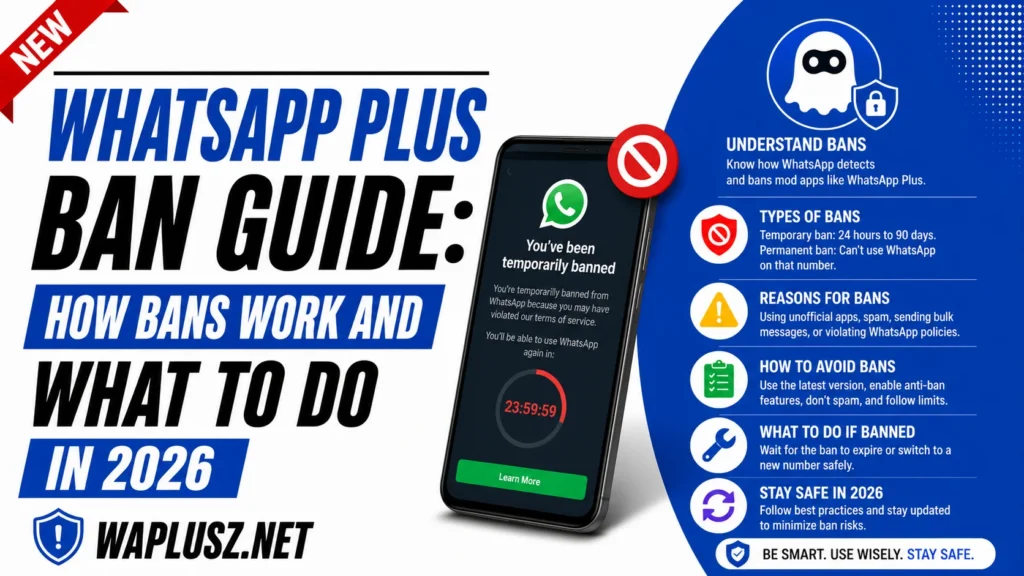
| First ban | Usually temporary, hours to days |
| Repeat bans | Escalating, then permanent |
| Permanent ban | Number unusable, appeals rarely succeed |
The pattern is that bans aren’t random and they aren’t constant. They come in waves tied to WhatsApp’s detection cycle, which is why users report years of no problems followed by a sudden ban.
Nobody’s build protected them during the quiet period. The detection just hadn’t caught up yet.
What Genuinely Reduces Your Risk
This is the useful part. None of these are guarantees, and all of them are better than a version number.
- Use a secondary number: The single most effective thing you can do. A ban costs you a spare SIM instead of your life.
- Avoid bulk messaging: This is the fastest ban trigger and it’s entirely within your control.
- Don’t message strangers at volume: Unsolicited messages generate reports, and reports bypass every technical trick.
- Keep the build current: Old builds are the ones detection has already caught up to.
- Don’t use it for business outreach: Marketing on a mod is asking for a permanent ban.
- Keep backups current: A ban is survivable, losing your history is the part that hurts.
- Enable two-step verification: It won’t stop a ban and it protects your number otherwise.
- Accept the risk honestly: If you can’t afford to lose the number, don’t put it on a mod.
If You’ve Already Been Banned
- For a Temporary Ban
- Wait it out. The timer counts down and using the app during it usually extends the ban. Don’t reinstall or try another build, which is how temporary becomes permanent.
- For a Permanent Ban
- Install official WhatsApp and request a review through the app. Appeals work occasionally and work better when you’re on the official client, since the first thing they check is what you’re running.
What Doesn’t Work
- Installing a different mod: You’re still on a modified client and the ban stands.
- A build claiming a higher anti-ban number: The number is invented and changes nothing.
- VPNs: Detection is client-side, not location-based.
- Clearing data and reinstalling: The ban is on your number, not your app.
- Waiting out a permanent ban: Permanent means permanent.
The only reliable route off a ban is the official app. That’s not a preference, it’s how the appeal process is built.
The Honest Answer to the Question
Will you get banned using WhatsApp Plus? Possibly. Maybe not this month, maybe not this year, and the risk doesn’t go away and doesn’t go down. It sits there for as long as you use a modified client, rising and falling with a detection cycle you can’t see.
Anyone telling you a version number solves this is selling you a download. The number costs them nothing to invent and costs you your number when it turns out not to be real.
That’s the whole picture. What you do with it is a reasonable decision either way, as long as you’re making it with the facts rather than the marketing. The safety guide and the ban recovery guide on WAPLUSOFICIAL.NET cover the rest.
Frequently Asked Questions
Partially and temporarily. It’s camouflage that WhatsApp learns to see through, which is why it’s patched constantly.
A marketing term. There’s no standard, no version history, and no organisation assigning the number.
There’s no timeline. Bans come in waves tied to detection updates rather than on a schedule.
Temporary bans expire on their own. Permanent bans need an appeal through the official app, and those rarely succeed.
It’s the most effective protection available, and it’s the only one that actually holds when detection catches up.
No. Detection is based on your client, not your location.